Sunday, December 9, 2012

Edward Steichen


Best known for his iconic photographs, Edward Steichen also experimented with landscape painting. He destroyed many of his canvases, and these tonalist nocturnes are are some of the surviving works.
Steichen used delicate washes of thinned oil colour, one over another, to create an opalescent effect and a mood of poetic reverie reminiscent of Whistler and George Innes.
This effect does not come across well in reproductions.
Steichen was born in Luxembourg and immigrated to the US as an infant in 1881. He died in 1973 at the ripe old age of 93.


Friday, November 30, 2012

Rivers


Corot, Le Ruisseau au Cheval Blanc, 46.9 x 72.3 cm.
Henri Biva, By the River.
Levitan.
Munnings.
Jorge Cerda Girones.

Thursday, November 1, 2012

Caspar David Friedrich, Quotes


After a long period during which his work was neglected and misunderstood (it was even associated with Nazism at one stage) Caspar Friedrich is now appreciated as a major figure in landscape painting, and perhaps the most important German painter of the Romantic period. His landscapes are unique, not only because they draw from a deep contemplation of Nature but because they reflect an inner world of eternal values.

Friedrich wrote a collection of aphorisms communicating his insights into painting. Here are some of them:

"Close your bodily eye, that you may see your picture first with the eye of the spirit. Then bring to light what you have seen in the darkness, that its effect may work back, from without to within."

"If he sees nothing within, then he should stop painting what is in front of him."

The painter should paint not only what he has in front of him, but also what he sees inside himself.

"What the newer landscape artists see in a circle of a hundred degrees in Nature they press together unmercifully into an angle of vision of only forty-five degrees. And furthermore, what is in Nature separated by large spaces, is compressed into a cramped space and overfills and oversatiates the eye, creating an unfavorable and disquieting effect on the viewer."

"The pure, frank sentiments we hold in our hearts are the only truthful sources of art. A painting which does not take its inspiration from the heart is nothing more than futile juggling. All authentic art is conceived at a sacred moment and nourished in a blessed hour; an inner impulse creates it, often without the artist being aware of it."

The Russian writer Aleksandr Turgenev wrote of Friedrich in his diary:

We visited Friedrich's atelier today. Listening to him and seeing his paintings was wonderful. He has some bonhomie which pleases people and his paintings reveal his romantic imagination. As a rule, he expresses in them one thought or feeling, though vaguely. You may meditate over his paintings but not have a clear understanding of them, for they are vague even in his soul. They are dreams or daydreams. He often employs very simple natural things, such as an ice block floating on sea waves, a few trees in a dale, window of his room (facing the beautiful Elbe), knight meditating over ruins or tombstones, monk staring into the distance or below his feet: all this captivates your soul, plunges you into dreams, all invokes your imagination, powerfully though vaguely.(6 August 1825)

Wednesday, October 3, 2012

Steps


Frederic Leighton, The Staircase of a House at Capri, 1859.
Henri Le Sidaner, Steps of the Palace at Versailles (Les Marches du Palais)


John Singer Sargent:
Santa Maria della Salute, 1906
The Steps of the Church of S. S. Domenico-e-Siste in Rome
Staircase in Capri, 1878

Friday, September 7, 2012

The Cloud Study

Cloud study, Anonymous.

The cloud study is a great plein air exercise. It's something you can do anywhere, even in the city, or in a landscape where the scenery at ground level is totally uninspiring. 
And because clouds are a moving target, it forces you to paint rapidly. Having a palette prepared with tonal strings of blues and greys would be a good idea, so that you don't waste time mixing. Adding a speck of yellow to the whites and violet to the grey shadows produces a nice complementary colour harmony.

Johan Dahl, Cloud study (Wolkenstudie)


Views of clouds reflected in water are an interesting variation, popularised of course by Monet.
Here's one by the Western Australian artist George Haynes.


Tuesday, August 21, 2012

Using Encaustic to Create Texture


Last night I watched a TV documentary about the life and work of the Australian artist Jenny Sages.
It was inspiring to learn that someone, who only took up a serious art career in her early 50s, went on to win many major awards in her chosen areas of landscape and portraiture.
The catalyst for her decision to take up fine art, full time, was a painting expedition to a remote area of the Australian outback. She said it was an epiphany for her; the landscape totally changing her palette and approach to making art. Her conversion was sudden and complete.
I've had a similar experience in central Australia - the colours there are indescribable opalescent pinks and greys. The desert regions, tend to lack the conventional elements of landscape subjects: trees, mountains and lakes, and lend themselves to abstraction.
Wanting to convey the complex textures of this ancient worn landscape, Sages took up the medium of encaustic (wax mixed with pigment). The melted wax is poured onto a board and spread over the surface, immediately creating interesting random textures and a kind of sculptural element. Sages then engraved the wax, gouging and scratching it with a variety of sharp implements, further adding to the texture. She then rubbed powdered pigment into the surface.

Though I have never used it myself, I have read that encaustic is compatible with the oil medium, and a great way to introduce texture into a landscape painting, whether it be representational or abstract.


Thursday, August 16, 2012

Massing for Impact


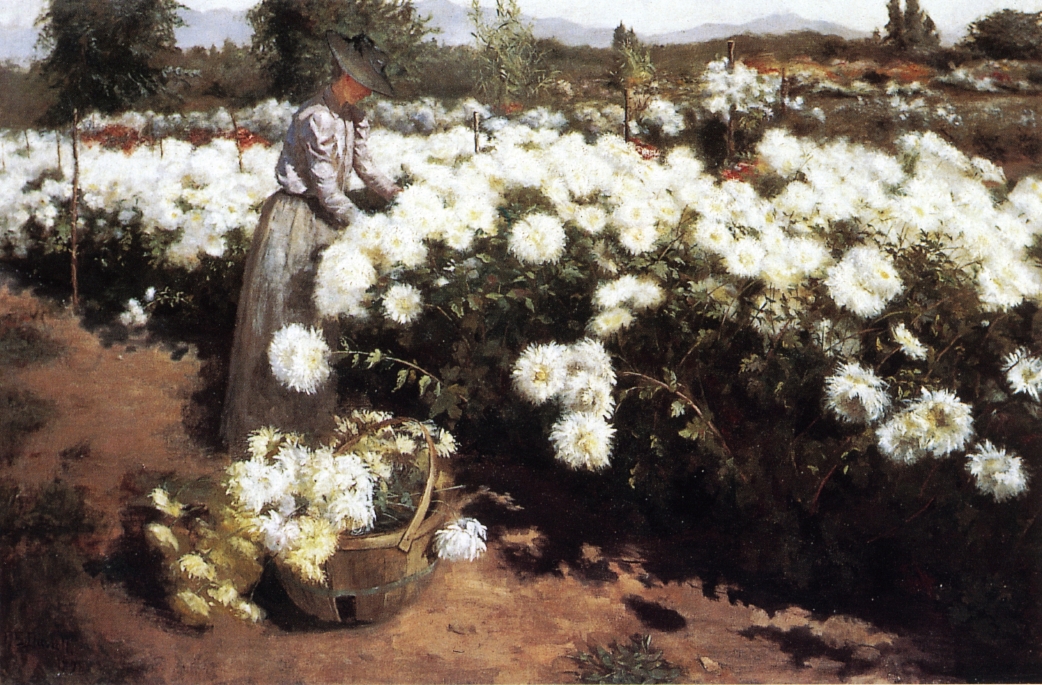
Top: Fannie Eliza Duval.
Middle: Unknown (Russian?).
Bottom: Gustave Caillebotte, Roses in the Garden at Petit Gennevilliers, 1886.

For maximum visual impact landscape gardeners often make mass plantings of the same flower.
This applies to paintings too.