Friday, September 7, 2012

The Cloud Study

Cloud study, Anonymous.

The cloud study is a great plein air exercise. It's something you can do anywhere, even in the city, or in a landscape where the scenery at ground level is totally uninspiring. 
And because clouds are a moving target, it forces you to paint rapidly. Having a palette prepared with tonal strings of blues and greys would be a good idea, so that you don't waste time mixing. Adding a speck of yellow to the whites and violet to the grey shadows produces a nice complementary colour harmony.

Johan Dahl, Cloud study (Wolkenstudie)


Views of clouds reflected in water are an interesting variation, popularised of course by Monet.
Here's one by the Western Australian artist George Haynes.


Tuesday, August 21, 2012

Using Encaustic to Create Texture


Last night I watched a TV documentary about the life and work of the Australian artist Jenny Sages.
It was inspiring to learn that someone, who only took up a serious art career in her early 50s, went on to win many major awards in her chosen areas of landscape and portraiture.
The catalyst for her decision to take up fine art, full time, was a painting expedition to a remote area of the Australian outback. She said it was an epiphany for her; the landscape totally changing her palette and approach to making art. Her conversion was sudden and complete.
I've had a similar experience in central Australia - the colours there are indescribable opalescent pinks and greys. The desert regions, tend to lack the conventional elements of landscape subjects: trees, mountains and lakes, and lend themselves to abstraction.
Wanting to convey the complex textures of this ancient worn landscape, Sages took up the medium of encaustic (wax mixed with pigment). The melted wax is poured onto a board and spread over the surface, immediately creating interesting random textures and a kind of sculptural element. Sages then engraved the wax, gouging and scratching it with a variety of sharp implements, further adding to the texture. She then rubbed powdered pigment into the surface.

Though I have never used it myself, I have read that encaustic is compatible with the oil medium, and a great way to introduce texture into a landscape painting, whether it be representational or abstract.


Thursday, August 16, 2012

Massing for Impact


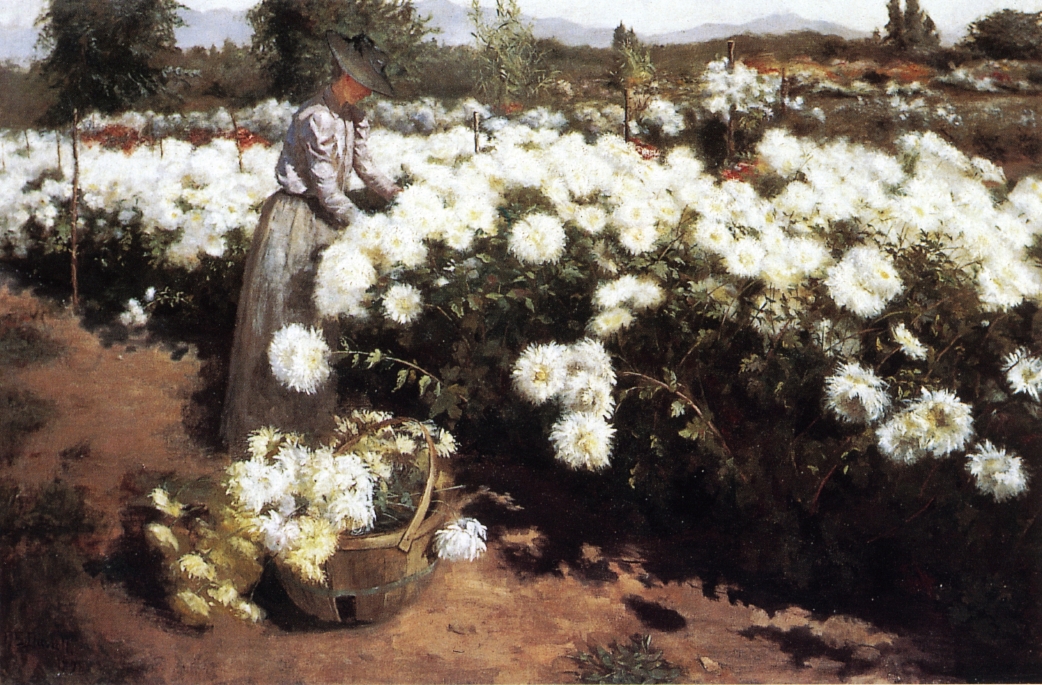
Top: Fannie Eliza Duval.
Middle: Unknown (Russian?).
Bottom: Gustave Caillebotte, Roses in the Garden at Petit Gennevilliers, 1886.

For maximum visual impact landscape gardeners often make mass plantings of the same flower.
This applies to paintings too.


Tuesday, July 24, 2012

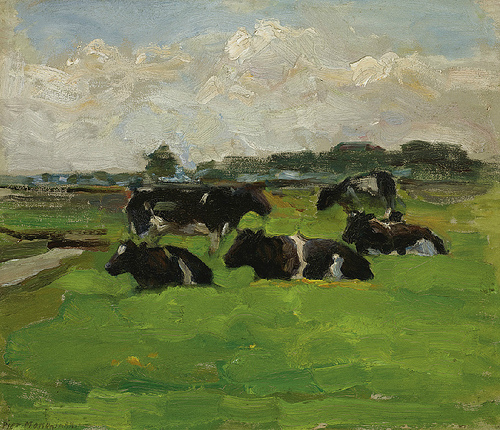
Cattle


Constant Troyon, Toques River, Normandy.
This work was greatly admired, in its day, for its evocation of light. It seems to have been a precursor of the Impressionist fascination with light and atmosphere.


Middle Image: Polder Landscape with Group of Five Cows.
In this early Piet Mondrian you can already see the simplification and repetition of forms that later developed into pure abstraction.

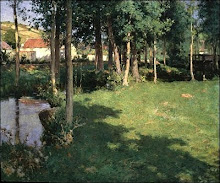
The last piece is by Cotman. A little gem of a painting. Cotman was a watercolourist but this piece is quite opaque in parts and may be gouache or oil.

Sunday, June 24, 2012

Edgar Payne


Edgar Payne's book "Composition of Outdoor Painting" is often recommended by landscape artists. It may be out of print, but there are often copies to be found online. There are some for sale at
www.amazon.com (A new copy is very expensive).


In the book, Payne categorises various types of composition to help the reader design their paintings rather than simply capturing random snapshots of the landscape. 
These compositional types are not intended to be fixed recipes. The artist should adapt them to use in original ways.
Compositional design does not imply that one is 'fudging' reality, it is simply a means of knowing what to look for when deciding what to paint.


Monday, May 21, 2012

Summer


Claustro de Georges Sands
Garden of Sa Coma, Valdemosa


In these two landscapes the Spanish (Catalan) painter Santiago Rusinol (February 25, 1861 - 1931) uses daringly bright greens to evoke the intense light of the mediterranean summer.
Rusinol was particularly fond of painting gardens, and was a supporter of modernism, who influenced Picasso.

Tuesday, May 8, 2012

Philip Wolfhagen

Third Exaltation


The study of clouds was my first interest within the genre of landscape painting and every few years I return to the subject with renewed enthusiasm. Often I am driven by dissatisfaction with my earlier efforts, always striving for a more refined palette and a lighter touch.
Third exaltation is one of a series of five large cloud paintings from 2011. In this painting I have worked over a pale citrus yellow ground, concentrating on paring back tonality to its bare minimum and allowing colour temperature to define pictorial depth.
- Philip Wolfhagen, 2012
This large scale work (I think it's about 3 x 3 m) was a finalist in the Wynne Prize this year, perhaps the most prestigious landscape prize in Australia.
Using a warm orange or yellow ground lends vibrancy to the blues and greys in skies.