Thursday, June 11, 2009

Dorrit Black - Australian


The Olive Plantation, 1946, 63.5 x 86.5 cm


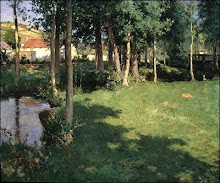
In the Foothills


Landscape painting of the 30's and 40's was often characterised by robust structure, reflecting the dramatic upheavals of the period. It's worth looking at these works if your landscapes have become too vague. Cezanne was the precursor of this kind of painting. Outlines are strong but also broken. Without this breaking of lines, the image would become captive and lifeless.
See also this work by Ross Dickinson

Tuesday, June 9, 2009

Emile Friant


Voyage a l'infini, 150 x 120 cm


Robert Havell


Sunlight streaming through glorious clouds produces a mood of the sublime.

Saturday, May 23, 2009

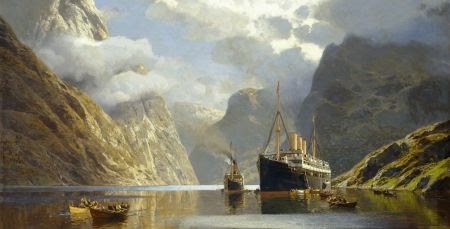
Karl von Eckenbrecher


The Auguste Victoria in the Naerofjord (detail) 1900

The strip of white water next to the dark hull of the ship creates a strong tonal contrast which draws the eye to a focal point. The lines in the slopes also lead the eye to this centre of interest.

Carl Gustav Carus


Mountain Scene, Montblanc Group, 1824


The equilateral triangle formed by the valley gives this work a strong sense of design which could otherwise have been overwhelmed by detail. Symmetry gives a sense of calm, even sacredness.

Sunday, May 17, 2009

Louis Remy Mignot - American 1831-1870


Niagara

The power of this image lies in the absence of superfluous elements. There are no overhanging trees framing the view, no human figures or structures; nothing to distract from the subject - water.

John F Carlson - American 1874-1947


February Gaiety, 25 x 30 inches

Colour must be added with great sensitivity to a work that is basically a monochrome image of whites, greys and blacks. A strong colour would be deafening in such a still scene.