Showing posts with label 19th century. Show all posts

Tuesday, June 27, 2023

Émile-René Ménard

L'Age d'or 1

L'Age d'or 2

L'Estuaire

Les Errants


Émile-René Ménard (1862-1930) was a French painter who was initially associated with the Barbizon school of landscape painters, but whose work looks back to classicism. His landscapes are typically rendered in the tranquil, subdued tones of twilight or dawn.

Monday, July 22, 2013

Turner: Glazing over Impasto


Recently I made the 3-4 hour car trip from Sydney to Canberra to see the Turner from the Tate exhibition at the National Gallery of Australia.
I had seen many of the works years ago at the Tate Gallery in London (which has the best collection of his much dispersed work), but an opportunity to see them in the flesh again was too good to pass up.

J. M. W. Turner (1775–1851) was one of Britain’s most original and inventive artists, a key figure of Romanticism, who influenced the Impressionists and even the Abstract Expressionists.

The exhibition includes several immense landscapes full of his ethereal brushstrokes and fascinating detail. These seem to glow as with an inner light, and are magnificently framed in monumental gilded mouldings. There are also many gem-like little watercolours to see.

A highlight of his later career is Venice, the Bridge of Sighs, 1840 (top and detail) in which he uses the oil technique of glazing over impasto. This technique gives the illusion of fine detail, without the need for laborious brushwork. 
The toxicity of real Lead White paint meant that it has been replaced by other pigments such as Titanium White. It's not easy to obtain these days, but some manufacturers of professional grade oil paints still make it - for a hefty price. Lead White it is particularly suited to the creation of fine impasto effects due to its ropey consistency, which can be manipulated into delicate peaks and cake-decoration-like swirls. 
Lead paint is fairly safe as long as the pigment is bound in the oil medium and not in a powder form, where it can be inhaled. You would not want to lick your brushes, as some artists I know have a habit of doing. I wouldn't recommend getting it on your skin either.
After the impasto has dried, a thin glaze of a contrasting grey or ochre is washed over it. The glaze collects in the depressions of the impasto, giving the impression of detail from a distance.
In Bridge of Sighs, Turner uses impasto only to pick out foci of interest, such as architectural details on the Doge's Palace. It looks as though he's used both an ochre yellow and a purplish grey glaze. Purple and yellow are complementary colours, so the effect, especially from a distance, is a kind of vibrating iridescence, later used by Monet to great effect to recreate sunlit walls.

Here are some photos the exhibition staff let me take (no flash allowed, so a little blurry, but better than I expected in the dimly lit gallery):


The last three images are details from the larger works.

More information about the exhibition here.

Friday, April 12, 2013

Golden Skies


Constant Troyon, A Clump of Trees, c.1860
George Inness, The Brook.

These works by Constant Troyon (top) and George Inness, make use of the golden light of dusk to suffuse the scenes with a sense of mystery. Warm golden hues - yellows sometimes with a touch of orange and red - are the perfect foil for dark grey-green foliage, creating a mood of soothing harmony.

The American landscape painter George Inness was so influential that he is often called "the father of American landscape painting". 
In his mature period, Inness discovered the spiritual writings of the Swedish mystic, Emanuel Swedenborg. The late paintings are poetic and mystical, with landscape views that are more intimate and personal, and a handling of shapes that is more abstract and nebulous than the earlier, more descriptive paintings.

In a published interview, Inness maintained that "The true use of art is, first, to cultivate the artist's own spiritual nature." His abiding interest in spiritual and emotional considerations did not preclude Inness from undertaking a scientific study of color, nor a mathematical, structural approach to composition: "The poetic quality is not obtained by eschewing any truths of fact or of Nature...Poetry is the vision of reality."
-Wikipedia

The glowing golden skies in these works would probably have been created by applying transparent glazes of a warm yellow over a white underpainting.


Geroge inness, The Monk, 1873.
Maple Screen, Hasegawa Tohaku.
It's possible that Inness was influenced by seeing the gold leaf backgrounds of Japanese folding screens (Byōbu), or it may have just been the symbolic association gold has with the Eternal.


Tuesday, July 24, 2012

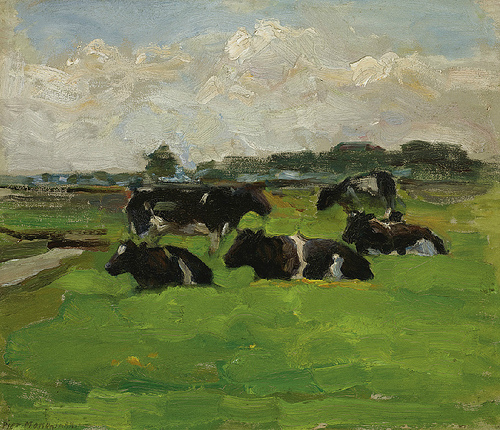
Cattle


Constant Troyon, Toques River, Normandy.
This work was greatly admired, in its day, for its evocation of light. It seems to have been a precursor of the Impressionist fascination with light and atmosphere.


Middle Image: Polder Landscape with Group of Five Cows.
In this early Piet Mondrian you can already see the simplification and repetition of forms that later developed into pure abstraction.

The last piece is by Cotman. A little gem of a painting. Cotman was a watercolourist but this piece is quite opaque in parts and may be gouache or oil.

Saturday, November 19, 2011

Fields


Charles Courtney Curran, American, A Breezy Day, 1887
Joaquin Sorolla y Bastida, Spanish, Prado de Asturias (Field in Asturias) 1903.


The simplicity of these two works is very attractive: just green and white with a hint of pink to complement.
A few years ago I bought a tube of cinnabar green light by Rembrandt. It's the best colour I have found for sunlit grass. The grass in the lower painting must have been painted with cinnabar or something close to it.


Rembrandt Cinnabar Green Light

Thursday, June 9, 2011

Google Art Project


I found this work ('Rye') by the Russian painter Ivan Shishkin, on Google Art Project, a wonderful tool that allows you to zoom  in to incredibly high resolution images of art in Major Galleries around the world. It's possible to look at the brushstrokes as if you were peering at the painting only a few inches away from the paint surface. 
One thing that I noticed right away was how thinly the oil paint was applied in many of the 19th century works. Up close they appeared like watercolours in some areas. In comparison, 20th century paintings tend to have much thicker paint layers.
Close up, you can see finely spattered whitish paint in the sky near the horizon, giving the effect of hazy distance.


There's no substitute for seeing a real painting in a gallery, but this comes very close.


www.googleartproject.com

Sunday, April 17, 2011

Alfred William Hunt

Wind of the Eastern Sea, by Alfred William Hunt (1830-96). Watercolour. England, 19th century.
Hunt balances the dark purplish shadows of the cliffs with the golden light of the sun on the horizon.

Tuesday, March 15, 2011

Prince Eugen


The Cloud, 1896
Prince Eugen was the son of the Swedish king and queen. He took up painting as a career, and was no mere royal dilettante. His parents, perhaps surprisingly for someone in his position, supported his decision.

Tuesday, March 8, 2011

Jungle Scene

Admiral Sir Edward Inglefield, The Blue Mountains of Jamaica, detail.

Saturday, December 25, 2010

Tuesday, July 20, 2010

Sunday, March 7, 2010

Albert Goodwin - British

The Sultan and his Camp by the Enchanted Lake 1888


I think this work is hanging in the Art Gallery of New South Wales.